You’re standing at the edge of the water, looking out and thinking the same thing everyone does at this stage: Okay… where do I even start?
Maybe it’s a dock for your home, something solid, safe, and built to last so weekends don’t turn into repair projects. Or maybe you’re responsible for a marina, a commercial facility, or an industrial site where a dock is critical infrastructure.
Either way, the moment you search for a dock contractor near me, the list looks long, the promises sound similar, and the stakes are higher than most people realize.
So what’s a good place to start?
You can certainly follow this guide.
It walks you through the questions that matter most and helps you focus on what actually affects the outcome of your dock,not just what sounds good in a proposal.
Let’s begin with the basics…
What Does a Dock Contractor Actually Do?
At first glance, it sounds simple.
You hire a dock contractor, and they build a dock. Done, right?
Not quite.
A good dock contractor does more than build. They connect your idea, engineering reality, and local regulations so the dock actually works where it’s being built, and keeps working years from now.
From a Vision to a Plan
You may start with a general idea: dock size, boat access, load requirements, or how the space needs to function.
A dock contractor evaluates whether that vision makes sense based on water depth, shoreline conditions, soil type, wave action, and usage, residential, commercial, or industrial.
Coordinating Design, Engineering, and Permits
When engineering is required, the contractor helps coordinate stamped designs and ensures the dock meets structural, environmental, and local code requirements.
Just as important, they understand the permitting process and help navigate the agencies involved so approvals don’t stall your project before construction even begins.
Building the Dock and Managing Risk
Once everything is approved, the contractor handles the construction, including materials, foundations, installation, and finishing details. More than that, they manage risk by identifying potential issues early, when they’re still easy to fix, not after the dock is already in the water.
How to Find a Reliable Dock Contractor Near Me
When you search dock contractor near me, you’re not really looking for the closest company on the map.
You’re looking for someone who understands your water, your regulations, and your risks.
In marine construction circles, this is where companies like us at Fender Marine earn our reputation not by being everywhere, but by knowing exactly how docks behave in real-world conditions.
Here’s how you can spot that level of reliability.
Start With Local Experience
Anyone can list a service area. What matters is the time spent actually working on your waterways.
- Completed projects in your region or similar environments.
- Familiarity with local soil conditions, tides, currents, and weather is huge in areas like Central Florida.
- Experience dealing with the same permitting agencies you’ll be dealing with.
This is the difference between a contractor who’s prepared and one who’s learning on your job.
Look for Design, Engineering, and Permit Knowledge
Dock projects don’t fail because someone forgot how to build; they fail because planning was skipped.
- A clear understanding of when engineering is required.
- The ability to coordinate stamped designs without confusion.
- Real experience navigating dock permits and regulatory approvals.
This kind of behind-the-scenes work is exactly what separates firms like Fender Marine from contractors who only show up once approvals are handed to them.
Ask Key Questions
Good dock contractors don’t flinch when you ask detailed questions. They lean in.
- Who handles design and engineering coordination?
- Who is responsible for permits and approvals?
- What challenges do you see with my site before construction starts?
- How do you plan for long-term performance, not just installation day?
Pay Attention to How They Communicate
Dock construction is complicated enough. Your contractor shouldn’t make it harder.
- Are responsibilities and expectations explained clearly upfront?
- Do they talk openly about risks, constraints, and trade-offs?
- Do they communicate like a partner, not a salesperson?
Clear communication is your guarantee against future misunderstandings
Look Beyond Pricing
It’s tempting to choose the lowest bid. It’s also how many dock horror stories start.
- Low bids often skip engineering or permit support.
- Material quality and installation methods can vary wildly.
- Fixing a poorly built dock costs far more than building it right the first time.
The goal isn’t the cheapest dock. It’s the one you don’t have to worry about every time the weather turns.
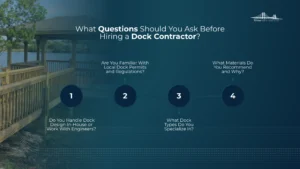
5 Questions to Ask Before Hiring a Dock Contractor Near You
Once you’ve narrowed down a few dock contractors, the real work begins: the conversations.
This is the part most people rush. They get a quote, hear a timeline, and assume the rest will work itself out. In reality, the questions you ask before anything is built are what determine how smoothly the project goes later.
These five questions will tell you almost everything you need to know.
1. Will You Handle the Dock Design, or Do I Need an Engineer?
Start here, because everything else depends on it.
Some docks can be built from standard designs. Others require engineering based on load, size, or environmental conditions.
A reliable contractor will explain whether engineering is required for your site, who provides stamped drawings, and how design decisions affect long-term performance, not just initial cost.
If the answer sounds vague or rushed, that’s a signal to slow things down.
2. How Do You Handle Dock Permits in This Area?
Ask which agencies are involved, who prepares and submits applications, and what a realistic approval timeline looks like based on local experience.
Contractors who work in your area regularly won’t guess here.
They’ll talk through the process with confidence and clarity.
3. What Types of Docks Do You Build Most Often?
Not all experience translates.
A contractor who builds residential docks every week may not be the right fit for a commercial or industrial facility, and vice versa.
Spare some time to check the types of projects they work on most, how those docks are used, and what challenges come with them.
4. Why Are You Recommending These Materials for My Dock?
This question shifts the conversation from price to performance.
Listen for explanations that connect materials to water conditions, usage, maintenance, and lifespan.
Good contractors will talk openly about trade-offs, not just advantages, and help you understand what you’re really investing in over time.
5. What Potential Issues Do You See With My Site?
Every dock site has constraints, soil conditions, depth, wave action, access, or permit limitations. A seasoned dock contractor will point those out early and explain how they plan to address them.
If someone says there are no challenges, they haven’t looked closely enough, and that’s a red flag.
Are Dock Contractors Properly Licensed and Insured?

This is one of the questions that might seem obvious…until it’s not.
Dock construction isn’t standard construction. It involves heavy equipment, work over water, and regulations that go well beyond a typical building project.
Licensing and insurance aren’t just formalities; they’re protections for you, your property, and everyone on site.
Before hiring a dock contractor, you should be comfortable asking about:
- State licensing specific to marine construction
- Active general liability and workers’ compensation coverage
- Insurance that applies to waterfront and over-water work
- Whether the crew on your dock are in-house employees or subcontractors
At Fender Marine, we’re Florida State Certified Building Contractors and State Certified Marine Contractors, and our licenses have never had a complaint against them. We carry the required workers’ compensation and marine insurance coverage, including U.S. Longshore and Harbor Workers’ Act coverage, which is required for this type of work.
We also utilize in-house employees, rather than subcontractors.
That gives us full control over quality, safety, and accountability from start to finish.
Do Dock Contractors Handle Engineering and Permits for You?
Short answer? Sometimes, and this is where you need clarity early.
Not every dock contractor offers the same level of service, and assumptions here can lead to delays, redesigns, or surprise costs. This is how it usually breaks down.
Engineering: Who’s Responsible and When It’s Required
Some docks can be built using standard designs. Others require engineering based on size, load, location, or regulatory requirements.
- Engineering may be required for larger, commercial, or industrial docks.
- Stamped drawings are often needed for permits and inspections.
- A qualified dock contractor should tell you up front if engineering is required.
Whether the contractor provides engineering in-house or coordinates with a marine engineer, the responsibility should be clearly defined before the project moves forward.
Permits: What a Dock Contractor Typically Handles
Permitting is one of the most misunderstood parts of dock construction.
- Identifying which agencies are involved (local, state, environmental, and waterway)
- Preparing and submitting permit applications.
- Coordinating documentation, drawings, and revisions.
- Responding to agency questions during review.
A contractor with local experience won’t treat this as an afterthought; they’ll plan for it from day one.
What “Full-Service” Really Means
When a dock contractor says they’re full-service, it’s worth asking what that actually includes.
- Do they coordinate engineering and permits, or just construction?
- Are permit timelines and responsibilities clearly outlined?
- Who manages changes if agencies require design adjustments?
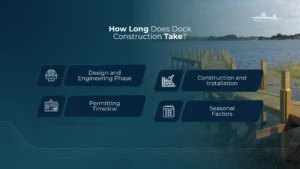
How Long Does Dock Construction Usually Take?
This is almost always one of the first questions you ask,and the honest answer is: it depends, but not as much as you might think.
In general, dock construction happens in phases, and each one plays a role in the overall timeline:
-
Design & engineering: Finalizing layout, load requirements, and site conditions
-
Permitting: Submitting plans and waiting on agency approvals
-
Construction: Mobilization, pile driving, framing, decking, and finishing
For many residential docks, construction itself may take days to a few weeks once permits are approved. Larger commercial or industrial projects naturally take longer due to scale, engineering complexity, and regulatory review.
The biggest variable? Permits and approvals, not the actual building process.
Do Dock Permits Require Signed and Sealed Drawings?
When it comes to dock permits, there’s one non-negotiable thing: engineered drawings.
For permitted dock projects, signed and sealed drawings are required as part of the application process.
These drawings define how the dock is built, inspected, and approved.
Here’s what that means for you:
- Engineering is part of the permitting process, not an optional add-on
- Drawings must be signed and sealed by a licensed engineer
- Permits are reviewed and issued based on those engineered plans
At Fender Marine, engineered detail drawings are included as part of the project when applying for permits. We coordinate the engineering, incorporate site-specific conditions, and make sure what gets approved is exactly what gets built.
This avoids a common problem in dock construction: designs that look fine initially but have to be revised mid-process to satisfy permitting agencies.
When engineering is handled correctly from the beginning, permits move faster, inspections go faster, and your construction stays aligned with expectations.
Signs You’re Hiring the Right Dock Contractor
By this point, you’ve asked the right questions, heard a few answers, and probably noticed something interesting: some dock contractors make you feel calmer… and some quietly raise your blood pressure.
Here’s how you know you’re dealing with the right one.
They Talk About Problems Before You Ask
A good dock contractor doesn’t wait for surprises.
- They point out site challenges early.
- They explain trade-offs instead of pretending everything is simple.
- They don’t promise perfection; they plan for reality.
Not to brag or anything, but this is one of those areas where Fender Marine tends to stand out. If there’s something that could affect your dock long-term, it’s better to hear about it now than during construction or worse, after.
They’re Comfortable Explaining
Design, engineering, and permits aren’t flashy, but they matter more than finishes.
- They explain why engineering may be required.
- They walk you through permits without hand-waving.
- They don’t disappear when paperwork enters the conversation.
They Sound Like Advisors, Not Salespeople
You’ll feel this almost immediately.
- No rushing you to lock it in.
- No avoiding detailed questions.
- No one-size-fits-all answers.
Instead, you’ll hear thoughtful explanations, realistic timelines, and honest guidance. The goal isn’t to sell you a dock, it’s to help you build the right dock.
Their Past Work Matches Your Project
This one’s big.
- Residential docks for homeowners look different from commercial or industrial docks.
- Load requirements, access needs, and durability expectations vary.
- Experience should align with how your dock will be used.
You Feel Informed, Not Overwhelmed
This might be the most underrated sign of all.
After talking with the right dock contractor, you should feel:
- Clear on next steps.
- Confident in the plan.
- A lot less stressed than when you started.
That’s the reaction Fender Marine aims for on every project. Because when dock construction feels confusing, something’s missing.
And when it feels clear? That’s usually because the right team is guiding it.
Final Thoughts: Hiring a Dock Contractor Near You With Confidence
If there’s one key takeaway you need to remember, it’s that hiring a dock contractor isn’t about finding anyone who can build over water. It’s about finding someone who understands your site, your regulations, and what this dock needs to handle long after construction is finished.
If you’re asking the questions in this guide, you’re already ahead of most projects.
You’re thinking about design, engineering, permits, and long-term performance, not just timelines and price tags.
That’s exactly how successful dock projects start.
And if, along the way, you find yourself talking with a contractor who explains things clearly, raises potential issues early, and makes the process feel manageable instead of overwhelming, that’s usually a sign you’re in good hands.
FAQs About Hiring a Dock Contractor Near You
Do I need permits to build a dock?
In most cases, yes. Dock construction typically requires permits from local, state, or environmental agencies. A qualified dock contractor should be familiar with these requirements and help guide the permitting process from the start.
Does a dock contractor handle engineering?
Sometimes. Some dock contractors provide design-build services, while others coordinate with licensed marine engineers.
What matters most is that engineering needs are identified early and clearly assigned, rather than being discovered halfway through the project.
How do I know if my dock needs engineering?
Engineering is often required for larger docks, commercial or industrial use, higher load requirements, or challenging water and soil conditions. A reliable dock contractor will evaluate your site and explain whether engineering is necessary for your specific project.
Is it better to hire a local dock contractor?
Yes. Local dock contractors understand regional water conditions, soil types, weather patterns, and permitting agencies. That local knowledge can prevent delays, redesigns, and long-term performance issues.
How long does it take to build a dock?
Timelines vary. Design and permitting can take weeks or months, depending on complexity and approvals. Construction itself is usually faster once everything is approved. A good dock contractor will set realistic expectations up front.
Should I choose the lowest dock construction bid?
Not always. The lowest bid may exclude engineering, permit support, or higher-quality materials. Over time, those shortcuts often cost more. Value comes from experience, planning, and durability, not just the initial number.