
When you’re responsible for a commercial or industrial waterfront facility, a failing seawall puts operations and safety at risk.
While it may seem like a straightforward fix, deciding whether to repair or replace a seawall is rarely simple.
Structural condition, load demands, soil stability, and constant exposure to waves, vessel traffic, and severe weather all affect what solution will actually hold up.
A quick visual inspection usually isn’t enough. The right choice depends on how the seawall is performing today, how it’s being used, and what it will need to support in the future.
So if you’re wondering whether a repair will truly last or if replacement makes more sense, the sections below focus on the real factors that drive long-term performance, not short-term fixes.
Repair vs Replacement: How to Make the Right Call
When a seawall begins to show signs of wear, the first question is usually whether it can be repaired or if it’s time to start over.
Depending on your specific settings, the answer might not be too obvious.
The key is understanding what’s happening beneath the surface and how your seawall is actually doing.
When Repair May Make Sense
In some cases, targeted repairs can extend the life of a seawall without major disruption to operations. Repair is often a good option when:
- The wall is structurally sound overall, with damage limited to light corrosion, surface cracking, or isolated sections.
- Tiebacks and anchors are still performing as designed.
- The seawall shows minimal settlement or movement.
These situations allow repairs to address specific problem areas while keeping costs and downtime under control.
When Replacement Is the Better Choice
Replacement becomes the best option when deterioration affects the seawall’s ability to do its job safely. This often includes:
- Widespread corrosion or material failure
- Loss of soil behind the wall or visible movement of the wall
- Increased load demands from equipment, traffic, or expansion
If you’re seeing repeated repairs or growing operational limitations, replacement may provide more reliability and long-term value.
Key Design Factors for Commercial and Industrial Seawalls

Once you start weighing repair versus replacement, design becomes a major part of the conversation.
Even if a seawall can be repaired, you need to know whether the existing design still works for the current requirements.
Commercial and industrial waterfronts tend to evolve, and seawalls that performed well years ago may now be dealing with very different demands.
Structural capacity
This is one of the first factors to review.
Lots of older seawalls were not designed for today’s equipment loads, storage requirements, or traffic patterns.
If repairs can restore strength without changing how the wall performs, they may be enough. On the other hand, if you go for replacement, you can have the structure redesigned to handle current and future loads.
Environmental exposure
Well, you can’t have a seawall totally isolated from the environment.
Wave energy, vessel wakes, tidal range, and storm surge all affect how a seawall ages.
In some cases, repairs can slow deterioration. In others, repeated exposure makes long-term performance difficult without a new system.
Soil and foundation conditions
These are another deciding factor. Settlement, scour, or loss of backfill might point toward replacement rather than patchwork repairs.
Common Seawall Types
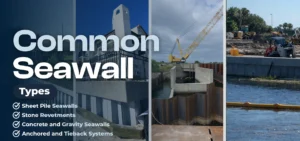
Next thing to do?
Check your current seawall type.
Each system behaves differently depending on the circumstances.
In many cases, the battle between repair and replacement comes down to whether the existing design can realistically be restored or if a new system would better support how the site operates today.
Sheet Pile Seawalls
Sheet pile seawalls are pretty common in ports, terminals, and working waterfronts because they offer strong lateral resistance with a relatively slim footprint.
Typical materials include:
- Steel sheet pile: Valued for high load capacity and suitability for heavy equipment, but vulnerable to corrosion over time.
- Vinyl or composite sheet pile: It resists corrosion but is generally limited to lower-load industrial applications.
Repairs can work when corrosion is isolated, alignment remains true, and tieback systems are performing.
Replacement becomes more practical when section loss is widespread, walls are leaning, or anchors can no longer be relied on.
Concrete and Gravity Seawalls
Concrete seawalls are found in older industrial facilities or locations designed for high-impact use.
These systems might rely on their mass to resist water and soil pressure rather than anchors. But most seawalls and bulkheads utilize tiebacks and deadmen in Florida.
While durable, they present challenges:
- Cracking, spalling, and reinforcing steel exposure can be difficult to address permanently.
- Undermining or settlement often affects the entire structure, not just one area.
In these cases, repairs may slow deterioration, but replacement allows for modern design standards and improved performance.
Anchored and Tieback Systems
Anchored seawalls use tie rods, deadmen, or anchor walls to increase stability, making them common in high-load or limited-space environments.
Key factors to evaluate include:
- The condition and accessibility of anchors behind the wall.
- Corrosion of tie rods and connection points.
- Whether anchor locations interfere with current or future site use.
If anchors are accessible and structurally sound, repairs can be effective. When anchor systems fail or become inaccessible, replacement often provides a safer, longer-lasting solution.
How to Choose The Best Materials?
Once you start looking beyond surface repairs, materials quickly become part of the repair-versus-replacement conversation.
In a commercial or industrial setting, you’re not just choosing what holds back soil and water; you’re choosing what can stand up to daily operations and exposure to harsh marine conditions.
Steel: Strong, Proven, and Demanding
Steel is often the go-to material for industrial seawalls because it handles heavy loads, vessel traffic, and equipment access well.
It works for both repairs and replacements. Bear in mind, however, it does require ongoing attention.
When you’re evaluating a steel seawall, consider:
- How much section loss has already occurred?
- Whether corrosion protection systems are still effective.
- If repairs will restore full structural capacity or only extend service life.
Localised corrosion can often be repaired. Widespread deterioration usually points toward replacement.
Concrete: Durable but Less Forgiving
Concrete can perform very well in aggressive marine environments, especially when it was originally designed for industrial use.
The challenge you’ll face is that once concrete starts to break down, your repair options become limited.
So replacement gives you a more reliable long-term solution than continued patchwork repairs.
Composite and Vinyl: Resistance with Limits
Composite and vinyl materials can be appealing if you’re dealing with ongoing corrosion and want to reduce maintenance demands.
You’ll usually see these materials discussed as part of a replacement strategy rather than a repair, especially when corrosion has been a recurring issue. As you evaluate these options, it helps to consider
- Load capacity compared to steel or concrete.
- Wall stiffness and allowable deflection.
- Suitability for current and future industrial use.
Looking beyond initial cost to long-term performance, maintenance, and adaptability usually leads to a more confident decision.
Designing for Longevity and Future Use
And speaking about long-term goals…
When you’re deciding whether to repair or replace a seawall, it helps to zoom out and ask a bigger question: what will this waterfront need to support five, ten, or twenty years from now?
Commercial and industrial sites rarely stay the same.
Equipment gets heavier, traffic increases, and regulations evolve. A seawall that works today may start to feel undersized sooner than expected.
It’s worth asking yourself a few practical questions early on:
- Are you planning future expansion or changes to how the site is used?
- Will new equipment, storage, or vehicle traffic increase load demands?
- Could higher vessel traffic or stronger wakes add stress to the wall?
Adaptability is another key factor. Some older seawalls were designed for a single purpose and leave little room for modification. Newer systems allow for:
- Additional tiebacks or reinforcement if loads increase.
- Height adjustments to account for water level changes.
- Phased construction that supports growth over time.
Climate-related impacts also play a role.
Higher water levels, stronger storms, and longer exposure cycles can all affect performance. Designing with these conditions in mind helps you avoid reactive repairs later.
Final Thoughts: Making a Confident Seawall Decision
Choosing between seawall repair and replacement comes down to understanding how the structure is really performing, and what your site needs moving forward.
Some seawalls can be repaired and continue to do their job. Others have reached a point where replacement offers more reliability, safety, and long-term value.
Commercial and industrial seawalls are pushed hard by loads, traffic, and the environment, so real-world experience matters.
At Fender Marine, we work on active commercial and industrial waterfronts every day, helping owners make practical decisions based on conditions, constructability, and long-term performance.
If you’re starting to question whether your seawall is still doing what it should, a professional evaluation can help you determine the smartest next step before problems escalate.
Frequently Asked Questions
How do you know if a seawall can be repaired instead of replaced?If damage is localised and the structure is still stable, repairs may extend its life. Widespread corrosion, movement, or soil loss usually points toward replacement.
How long do commercial and industrial seawalls last? Lifespan varies by design, material, and exposure, but many last decades. Increased loads and corrosion can shorten service life without proper maintenance.
Is seawall replacement more expensive than repair? Replacement costs more upfront, but repeated repairs can become more expensive over time, especially if they don’t fix underlying issues.
How disruptive is seawall replacement for active facilities?With proper planning and phasing, replacement can often be completed while operations continue, minimising downtime.
When should you bring in a marine contractor?As soon as performance or safety becomes a concern. Early evaluation helps avoid emergency repairs and costly delays.