
Docks are a core part of any waterfront property.
But when it comes time to build or replace one, there’s a question you need to consider: should it be a floating or a fixed dock?
In Florida, that choice usually revolves around water levels, storm exposure, permitting rules, and long-term performance.
No, choosing a fixed or a floating dock isn’t about looks.
It’s a matter of convenience and suitability.
This article is here to help you understand which dock type actually makes sense for your property.
What’s the Difference Between Floating and Fixed Docks?
Quick answer? Their behavior is different.
So… docks have behavior?
Most certainly.
The real difference between floating and fixed docks isn’t how they look, it’s how they respond to the water, the weather, and the conditions around them.
And in Florida, that response can make or break how well a dock performs over time.
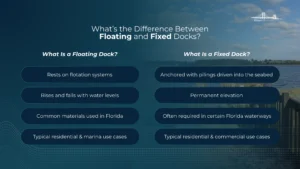
Floating Docks
A floating dock sits on the water, supported by flotation beneath the deck. Instead of resisting changing conditions, it moves with them.
As water levels rise or fall, the dock rises and falls right along with them.
That flexibility is why floating docks are often chosen in areas with tides, seasonal fluctuations, or unpredictable water levels, common realities across much of Florida.
Because they adapt to their environment, floating docks tend to maintain consistent access to the water, even when conditions change.
Fixed Docks
A fixed dock takes a very different approach.
Rather than moving with the water, it’s anchored into the ground using pilings driven into the seabed. Once installed, the dock stays at a set elevation, no matter what the water level does.
This rigidity can be an advantage in areas with stable water levels or when heavier loads are involved. But it also means fixed docks rely heavily on proper engineering and site conditions to perform well over time, especially during storms.
Florida-Specific Factors That Should Drive Your Decision
Okay, now that you know the basics, let’s move on to the fun part.
This is where Florida starts doing Florida things, and where dock decisions stop being theoretical and start being very real.
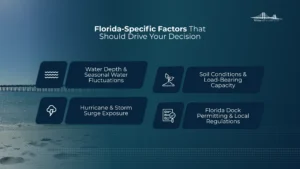
Water Depth and Seasonal Water Fluctuations
Not all Florida waterfronts behave the same.
A tidal bay, a man-made canal, and a freshwater lake might look similar on a map, but they act very differently in real life.
- Tidal areas deal with daily rises and falls.
- Lakes fluctuate with rainfall and drought cycles.
- Canals can change based on water management systems and tides.
This is where floating docks often shine. Because they move with the water, they stay usable even when levels change. They are flexible as that.
Fixed docks, on the other hand, don’t adapt. If the water level changes enough, access and usability can become a problem.
Soil Conditions and Load-Bearing Capacity
What’s underneath your dock matters just as much as what’s on top of it.
Florida seabeds can range from firm sand to soft, muddy sediment. And that difference plays a huge role in how well a dock performs over time.
Fixed docks rely on pilings being driven deep enough into stable soil. If the seabed isn’t properly evaluated, or the pilings aren’t engineered correctly, the dock can settle, shift, or fail altogether.
Floating docks distribute weight differently and don’t rely on deep soil support in the same way, which can make them a safer option in softer or less predictable seabed conditions.
Hurricane and Storm Surge Exposure
Let’s address the big one.
Florida storms.
During hurricanes and storm surge events, docks don’t just get wet,they get tested.
- Floating docks rise with the surge and can reduce structural stress
- Fixed docks resist movement, which means forces are transferred into the pilings and connections
Neither option is storm-proof by default. How a dock performs in extreme weather depends far more on engineering and construction quality than on dock type alone.
A well-designed dock accounts for wind loads, surge, wave action, and debris, not just normal conditions.
Florida Dock Permitting and Local Regulations
Here’s where you need to pay close attention.
Dock regulations vary widely across Florida. Some counties and municipalities:
- Restrict or prohibit floating docks.
- Require specific setbacks or materials.
- Enforce environmental protections for seagrass and marine life.
Choosing a dock type that isn’t permitted in your area can mean delays, redesigns, or outright rejection.
This is why early professional input matters. Understanding local rules before finalizing a design can save months and a significant amount of money before construction even begins.
Which Dock Type Is Best for Your Florida Property?
With all we have reviewed so far, there’s one important remaining question…
How can you know which option is better for you?
Here’s a straightforward way to think about it.
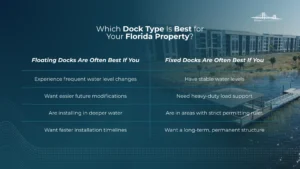
Floating Docks Are Often Best If You:
- Experience frequent water level changes: If tides, rainfall, or seasonal shifts regularly change your water level, a dock that moves with the water tends to stay usable year-round.
- Want easier future modifications : Floating docks are generally simpler to expand, reconfigure, or adjust later on, useful if your needs change or you upgrade your boat.
- Are installing in deeper water: In deeper areas, floating docks can reduce the need for long pilings and complex foundation work.
- Want faster installation timelines: Fewer structural variables often mean quicker installation compared to fully driven piling systems.
Fixed Docks Are Often Best If You:
- Have stable water levels: If your water height stays relatively consistent, a fixed dock can provide a solid, predictable platform.
- Need heavy-duty load support: Larger vessels, lifts, or higher load requirements often favor the rigidity of a fixed structure.
- Are in areas with strict permitting rules: Some Florida counties and municipalities limit or prohibit floating docks, making fixed docks the only viable option.
- Want a long-term, permanent structure: Fixed docks are built with permanence in mind and are often chosen for properties planning decades of use.
Cost Considerations: Floating vs Fixed Docks in Florida
When cost comes up, most people want a simple answer.
The reality? Dock pricing depends heavily on site conditions, materials, permitting, and how well the dock is designed from the start.
That said, there are some consistent cost patterns worth understanding.
Typical Cost Ranges
In general terms:
- Floating docks often come with a lower upfront cost range, especially in deeper water or areas with variable conditions.
- Fixed docks typically fall within a higher upfront range, driven by factors such as pilings depth, soil conditions, and structural requirements.
These are ranges, not rules. A poorly suited floating dock can quickly outprice a well-designed fixed dock, and vice versa.
Installation Complexity Differences
Installation plays a major role in the overall cost.
Floating docks tend to involve:
- Less invasive foundation work.
- Fewer variables are tied to soil conditions.
- Shorter construction timelines in many cases.
Fixed docks require:
- Pile driving and seabed evaluation.
- Precise engineering based on load and soil.
- More coordination with permitting and inspections.
Long-Term Maintenance Costs
Because any good dock demands some level of maintenance, you need to consider this as well.
Floating docks often require:
- Periodic flotation inspections.
- Hardware and connection maintenance.
Fixed docks may require:
- Piling inspections over time.
- Repairs due to settlement, shifting, or storm stress.
Common Dock Design Mistakes Florida Property Owners Make
Most dock problems don’t show up right away. They start to be an issue slowly, maybe it happens after the first big storm, after a few seasonal water changes, or when the dock just doesn’t feel quite right anymore.
And in most cases, the issue isn’t the dock itself.
It’s the decisions you made before it was built.
Choosing a Dock Type Before Evaluating the Site
One of the most common mistakes is picking a dock type based on appearance, price, or what a neighbor has, before understanding the property’s actual conditions.
Water depth, fluctuation patterns, soil composition, and exposure all influence how a dock will perform. When those factors aren’t evaluated first, even a well-built dock can struggle in the wrong environment.
Underestimating Water Movement and Storm Impact
Florida waterways are rarely static.
Tides, rainfall, boat traffic, and storms all introduce movement and force that a dock has to handle every day.
Designing for calm conditions instead of real-world conditions often leads to accelerated wear, structural stress, or storm damage that could have been avoided with proper planning.
Ignoring Permitting and Environmental Requirements
Permitting is often treated as a formality, until it isn’t.
Local regulations can dictate dock size, materials, placement, and even dock type. Skipping early permitting considerations can result in redesigns, delays, or being forced to modify a finished structure to comply.
Environmental protections add another layer, especially in sensitive waterways where seagrass and marine habitats are involved.
Hiring a Contractor Without Marine-Specific Experience
Not all construction experience translates to marine construction.
Docks operate in a harsh, constantly changing environment. Without experience specific to waterfront structures, small design oversights can turn into long-term problems. Engineering, materials, and installation methods matter far more on the water than they do on land.
FAQs: Floating vs Fixed Docks in Florida
Are floating docks allowed in Florida?
In many areas, yes, but it depends on local and county regulations.
Some municipalities restrict or prohibit floating docks, especially in environmentally sensitive waterways. This is why permitting should be reviewed early, before a dock type is selected or designed.
Do floating docks hold up in hurricanes?
They can, when properly designed and installed. Floating docks rise with storm surge, which can reduce certain stresses, but performance during storms depends heavily on engineering, anchoring systems, and materials, not just dock type alone.
How long do fixed docks last in Florida?
A well-built fixed dock can last decades, but longevity depends on piling quality, soil conditions, exposure to storms, and ongoing maintenance. Poorly engineered pilings or unsuitable site conditions can shorten that lifespan significantly.
Which dock type requires less maintenance?
Neither option is maintenance-free. Floating docks require regular inspection of flotation and connections, while fixed docks require monitoring of pilings and structural components. The right dock for the right site typically results in lower long-term maintenance overall.