
You don’t usually notice dock problems the day they start.
Most of the time, everything looks fine, the boards feel solid, the pilings look straight, and nothing seems urgent. Then one day, something feels off.
That’s how dock failures usually show up, in silence, and long before they become obvious.
What many dock owners don’t realize is that these early warning signs are rarely about the surface.
They’re usually tied to what’s happening below the waterline and inside the dock’s structural design. Pilings shift, loads change, materials wear down, and small miscalculations begin to accumulate.
Understanding what fails first, and why, makes a big difference.
It helps you spot problems early, know when a repair is enough, and recognize when it’s time to bring in a marine construction specialist before a minor issue turns into a major rebuild.
Let’s start with the dock piling and structural failures that tend to show up first.
The 6 Most Common Dock Piling and Structural Failures
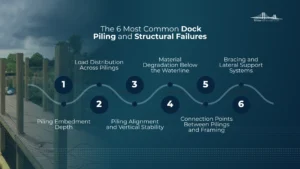
1. Piling Embedment Depth
What fails first
This is usually the first issue to develop, even though it’s the hardest to spot. When pilings aren’t driven deep enough, they don’t fail all at once; they slowly work themselves loose.
You might notice a dock that feels a little less solid than it used to, or movement that wasn’t there before.
Why it happens Most of the time, this traces back to how the dock was originally built. The conditions below the waterline matter just as much as what you can see above it.
- Soil conditions weren’t properly evaluated.
- Wave action and tidal movement were underestimated.
- Shortcuts were taken during the original piling installation.
What it leads to
Once pilings begin to move, the effects spread through the entire structure.
- Increased dock movement.
- Structural shifting across the frame.
- Premature piling replacement instead of simple repairs.
2. Load Distribution Across Pilings
What fails first
This issue usually shows up after a dock has been in use for a while. Everything looks fine at first, but over time certain sections start to sag or feel heavier underfoot. That’s often a sign the dock’s weight isn’t being shared evenly across its pilings.
Why it happens
Load problems tend to develop when a dock’s design no longer matches how it’s being used.
- Pilings were spaced incorrectly from the start.
- The dock was expanded without reworking the structural layout.
- Added equipment, lifts, or traffic increased the overall load.
When weight concentrates in the wrong areas, some pilings end up doing far more work than they were designed to handle.
What it leads to
Uneven load distribution doesn’t stay isolated for long.
- Sagging or uneven dock sections.
- Stress on framing and connections.
- Structural damage that requires professional dock repair or redesign.
3. Piling Alignment and Vertical Stability
What fails first
A piling that used to look straight now leans just enough to catch your eye. The dock still works, but something about it feels strange, especially after heavy weather or increased boat traffic.
Why it happens
Pilings are constantly pushed and pulled by lateral forces, and if they weren’t installed with those forces in mind, they eventually lose alignment.
- Improper driving techniques during installation.
- Currents and wave action not fully accounted for in the design.
- Insufficient bracing to resist side-to-side movement.
Over time, that repeated pressure causes pilings to shift from their original position.
What it leads to
When pilings lose vertical stability, the dock starts to respond in ways it shouldn’t.
- Sections pulling out of alignment.
- Increased stress on framing and fasteners.
- Dock repairs that go beyond surface-level fixes
4. Material Degradation Below the Waterline
What fails first
Have you ever looked at your dock and thought everything seemed fine, only to later find out the real problem was hiding below the surface?
That’s exactly how material degradation shows up. The portions of pilings you can’t see often wear down faster than the sections above the waterline.
Why it happens
Marine environments are tough on materials, especially when they’re constantly submerged.
- Exposure to marine borers, rot, or corrosion.
- Materials not suited for local water conditions.
- Normal wear accelerated by constant moisture and movement.
Because the damage happens out of sight, it often goes unnoticed until strength is already compromised.
What it leads to
This is something that can be a serious problem fast.
- Hidden structural weakness.
- Sudden safety concerns.
- Emergency piling replacement rather than planned repairs.
5. Connection Points Between Pilings and Framing
What fails first
Picture stepping onto your dock and noticing a section that doesn’t feel as tight as it used to. Nothing is obviously broken, but there’s a bit of movement where there shouldn’t be. In many cases, the issue isn’t the piling itself, it’s the connection point where the piling meets the framing.
Why it happens
Those connection points absorb constant motion, and over time that stress adds up.
- Non-marine-grade hardware used during construction.
- Fasteners slowly weakened by corrosion.
- Connections that weren’t designed to handle continuous movement
What starts as a small amount of play can quickly spread as the dock flexes.
What it leads to
Once connections begin to loosen, the structure loses its integrity.
- Shifting or unstable dock sections.
- Increased strain on surrounding framing.
- Repairs that go well beyond tightening a few bolts.
6. Bracing and Lateral Support Systems
What fails first
Does your dock feel solid one day and slightly unstable the next? That kind of movement is often a sign that the bracing and lateral support system isn’t doing its job, even if the dock looks fine at first glance.
Why it happens
Bracing is what resists side-to-side forces, and it’s frequently underestimated during design or construction.
- Cross-bracing was simplified or left out.
- Lateral loads weren’t fully accounted for.
- The dock was modified without updating its support system.
Without proper bracing, even well-installed pilings end up carrying stresses they weren’t designed to handle.
What it leads to
As lateral support weakens, overall movement increases and structural wear accelerates.
- Racking and twisting across the dock.
- Faster deterioration of framing and connections.
- Structural reinforcement or full dock reconstruction.
Why These Dock Failures Usually Require a Marine Construction Specialist
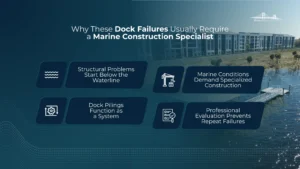
Structural Problems Start Below the Waterline
Most dock issues don’t start where you can see them.
By the time something feels loose or looks out of alignment, the real changes have already been happening below the surface. Pilings shift, framing takes on stress, and water does what it always does: it finds the weakest point. That’s why surface-level fixes rarely address the full problem.
Dock Pilings Function as a System
A dock doesn’t rely on one piling at a time.
Every piling shares the load, reacts to movement, and supports the structure as a whole. When one part starts to fail, the stress doesn’t disappear, it gets redistributed. That’s often why isolated repairs seem to help at first, only for new problems to show up somewhere else.
Marine Conditions Demand Specialized Construction
Docks live in constant motion. Tides rise and fall, currents apply pressure, and boat traffic adds forces that don’t exist in standard construction.
Designs that work on land don’t always translate to the water. Without accounting for those conditions, even well-built docks can wear down faster than expected.
Professional Evaluation Prevents Repeat Failures
The value of a marine construction specialist isn’t just in fixing what’s broken, it’s in identifying what’s about to fail next.
Professional inspections look at how the entire structure is performing, not just the most obvious issue. Catching problems early often means fewer repairs, smarter solutions, and a dock that holds up over time.
Final Thoughts: Catching Dock Problems Before They Escalate
At this point, you probably know that dock problems rarely happen overnight.
They remain in silence until something bursts out
Knowing what fails first gives you an advantage; it helps you recognize when a simple fix is enough and when it’s time to look deeper.
That’s where working with an experienced marine construction specialist makes the difference. Fender Marine helps dock owners evaluate structural conditions, address piling-related issues, and build solutions designed to perform in real marine environments, not just look good on the surface.
A professional evaluation today can prevent far more costly repairs down the line.
Frequently Asked Questions About Dock Pilings and Structural Failures
How do I know if my dock piling depth is a problem?
Early signs often include increased movement, sagging sections, or pilings that no longer feel firmly set.
Because embedment depth issues start below the waterline, a professional inspection is usually the most reliable way to identify them.
Can dock piling problems be repaired without replacement?
In some cases, yes. Minor issues can sometimes be addressed with reinforcement or structural adjustments. However, when pilings have shifted or deteriorated significantly, replacement is often the safest and most cost-effective long-term solution.
How often should dock pilings be inspected?
Dock pilings should be inspected regularly, especially after severe weather or increased usage. Professional marine inspections help identify early structural changes before they require major repairs or reconstruction.
Why can’t a general contractor repair the dock’s structural issues?
Dock construction involves constant exposure to water, tides, and lateral forces that aren’t present in standard construction. Marine construction specialists are trained to account for these conditions when repairing or rebuilding docks.
What usually causes repeated dock repairs?
Repeated repairs often happen when only surface-level damage is addressed.
Without evaluating piling depth, load distribution, bracing, and material condition, underlying structural issues continue to progress.
When should I contact a marine construction specialist?
If you notice persistent movement, structural shifting, leaning pilings, or recurring repair issues, it’s a good idea to contact a specialist.
Early evaluation can prevent minor problems from turning into full dock reconstruction projects.