
You’re standing at the edge of your waterfront, asking a simple question: Should you go with a standard dock or invest in a custom one?
In theory, the choice looks straightforward.
One is faster, more affordable, and ready to install. The other takes more planning, more engineering, and a bigger upfront commitment.
But once you start thinking about vessel traffic, long-term maintenance, permitting, and how your dock actually needs to perform day in and day out, that decision gets a lot more complicated.
If you’re managing a marina, commercial waterfront, or industrial site, your dock is an operational asset. It affects safety, efficiency, downtime, and costs long after installation day is over. And choosing the wrong solution for your site can mean constant repairs, operational bottlenecks, or premature replacement.
That’s why the real question isn’t custom dock vs standard dock, it’s which option is designed to work for how you actually use your waterfront.
In the sections below, we’ll break down the key differences so you can make the best decision for your property’s requirements.
What Is a Standard Dock?
Definition (Prefabricated / Modular / Off-the-Shelf)
A standard dock is a prefabricated or modular docking system built from pre-engineered components.
These docks are manufactured off-site and assembled at the waterfront, offering an off-the-shelf solution designed to meet common docking needs rather than site-specific requirements.
Because the design is already established, you’ll find that customization is generally limited to overall size and basic layout, not structural engineering or operational flow.
Typical Materials and Configurations
Most standard docks are built using widely available materials like aluminium framing combined with treated wood or composite decking.
The layouts themselves are familiar and straightforward, the kinds you’ve probably seen at dozens of waterfronts.
Common configurations include:
- Straight dock runs.
- L-shaped layouts.
- T-dock configurations.
Common Use Cases
Standard docks tend to make the most sense when conditions are predictable, and usage doesn’t change much over time.
If your waterfront sees consistent vessel sizes, light traffic, and minimal operational complexity, this type of dock can get the job done.
You’ll most often find standard docks at:
- Low-traffic waterfronts.
- Smaller or private facilities.
- Sites without significant environmental challenges.
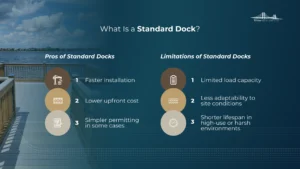
Pros of Standard Docks
One of the biggest reasons people choose a standard dock is, of course, speed.
With little to no engineering required, projects move faster from approval to installation.
Other advantages include:
- Faster installation timelines.
- Lower upfront cost.
- Simpler permitting in some cases, especially for straightforward sites.
Limitations of Standard Docks
Where standard docks start to show their limits is when conditions become less predictable. These systems are typically designed for lighter, consistent loads — not for heavy traffic, large vessels, or evolving operational demands.
Some common challenges include:
- Limited load capacity
- Less adaptability to unique site conditions
- Shorter lifespan in high-use or harsh environments
Over time, these constraints can translate into increased maintenance, downtime, and higher long-term costs.
What Is a Custom Dock?
Definition (Engineered and Site-Specific)
A custom dock, as the name hints, is a site-specific docking system, designed around how you actually use your waterfront.
Instead of forcing your operations to fit a pre-set layout, the dock is planned from the ground up to match your site conditions, vessel mix, and long-term needs.
It’s an ideal option when you want the dock to align with how boats move, how people work, and how the waterfront functions day in and day out, not just how it looks on paper.
Typical Materials and Configurations
As we have just seen, custom docks are engineered for a specific purpose, so materials and layouts aren’t chosen off a list; they’re selected based on performance.
That often means heavier-duty structural components, marine-grade materials, and reinforcements where the dock sees the most stress.
Configurations are shaped by use rather than standard geometry. This might include wider berthing areas, reinforced edges, integrated utilities, or layouts that improve traffic flow and safety.
Common Use Cases
Custom docks make the most sense when your waterfront sees consistent use, varied vessel sizes, or challenging environmental conditions. Think about your property. Is your dock a working asset? A custom solution certainly gives you far more control.
You’ll most often find custom docks at:
- Commercial marinas.
- Industrial and working waterfronts.
- Sites with heavy traffic or environmental exposure.
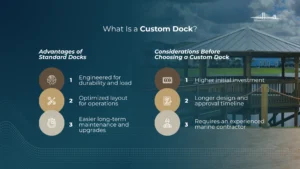
Pros of Custom Docks
The main advantage of a custom dock is that it’s built to perform.
Engineering decisions are made with real-world conditions in mind, which for you means better durability and operations over time.
Some of the key benefits include:
- Load capacity designed for your actual vessels and equipment.
- Greater adaptability to tides, wave action, and soil conditions.
- Longer lifespan with fewer reactive repairs.
Limitations of Custom Docks
Everything that requires some degree of personalization takes more planning.
Design, engineering, and permitting usually require more time, and the upfront investment is higher compared to a standard system.
Things to consider:
- Longer design and approval timelines.
- Higher initial cost.
- Dependence on experienced marine engineers and contractors.
For high-use waterfronts, those trade-offs are often outweighed by improved performance, reduced downtime, and stronger long-term value.
Custom Dock vs Standard Dock: Key Differences
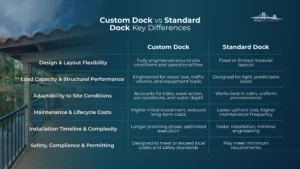
Now that we have a clearer idea of what a custom dock and a standard dock actually are, let’s move on to the fun part, actually discovering where the differences really show up.Once you move past definitions and start looking at how each option performs in real-world conditions, the choice usually becomes a lot easier.
Design and Layout Flexibility
- Standard Dock: Fixed or limited modular layouts that work well for general use but leave little room to adapt flow or spacing.
- Custom Dock: Fully engineered around site conditions and operational flow, designed to support how vessels arrive, berth, and move through your waterfront.
This matters more than it sounds; layout impacts vessel access, safety, and how efficiently your dock operates on busy days.
Load Capacity and Structural Performance
- Standard Dock: Designed for light, predictable loads and consistent vessel sizes.
- Custom Dock: Engineered for your actual vessel mix, traffic volume, and equipment loads.
For those of you who own commercial and industrial sites, this difference is huge. Load capacity can and will directly affect durability, safety, and long-term performance.
Adaptability to Site Conditions
- Standard Dock: Performs best in calm, uniform environments with minimal variation. Perfect for places where routine is the norm.
- Custom Dock: Accounts for tides, wave action, soil conditions, and water depth from the start.
If your site isn’t perfectly predictable, and let’s be honest, the weather in Florida rarely is, adaptability plays a major role in how well the dock holds up over time.
Maintenance and Lifecycle Costs
- Standard Dock: Lower upfront cost, but often higher maintenance frequency as usage and conditions push its limits.
- Custom Dock: Higher initial investment, typically offset by reduced maintenance and longer service life.
Depending on the use you give to it, a relatively affordable standard dock might end up costing thousands of dollars more.
Installation Timeline and Complexity
- Standard Dock: Faster installation with minimal engineering and shorter lead times.
- Custom Dock: Longer planning phase, followed by a more optimised and purpose-built execution.
Safety, Compliance and Permitting
- Standard Dock: May meet minimum requirements for low-impact or low-traffic applications.
- Custom Dock: Designed to meet or exceed local codes, safety standards, and permitting requirements.
For regulated, high-use waterfronts, that extra margin of compliance can make all the difference.
Which Dock Is Right for Your Waterfront?
When a Standard Dock Makes Sense?
If your waterfront is relatively calm, sees light and predictable traffic, and your needs aren’t likely to change much over time, a standard dock can be a perfectly reasonable choice. It’s straightforward, quicker to install, and easier on the upfront budget.
This option tends to work best when the dock’s role is simple, and the conditions don’t ask too much of it.
When a Custom Dock Is the Better Fit?
On the other hand, if your dock plays a bigger role in daily operations, handling frequent traffic, larger vessels, or less predictable conditions, a custom dock usually becomes the smarter long-term option. It’s designed around how your waterfront actually functions, not how a generic layout assumes it will.
Yes, it takes more planning upfront, but that planning is what helps reduce downtime, maintenance headaches, and future limitations as your operation grows or evolves.
Key Questions to Ask Before Choosing
Before you lock in a design or get attached to a specific option, it helps to pause and ask a few honest questions.
These are the ones that usually make the answer much clearer.
What types of vessels will use the dock?
Think beyond what’s there today. Vessel size, weight, and docking style all influence layout, load capacity, and durability.
A dock that works for smaller boats may struggle once larger or heavier vessels enter the picture.
How much daily traffic is expected?
Occasional use and constant movement are two very different realities. If your dock sees frequent arrivals, departures, or peak-hour congestion, that level of activity should be built into the design from the start.
What environmental factors are at play?
Water depth, tides, wave action, wakes, wind, and soil conditions all matter, even if they don’t seem dramatic at first glance. These factors often determine whether a standard solution holds up or starts showing wear sooner than expected.
Are future expansions planned?
If there’s any chance your operation will grow, expand, or change, it’s worth planning for that now. Designing with future flexibility in mind can save you from costly modifications later.
Final Thoughts: Making the Right Dock Decision
Choosing between a standard dock and a custom dock ultimately comes down to what works best for your property.
If your needs are simple and conditions are predictable, a standard dock can be a practical, efficient solution. But if your dock supports daily operations, heavier traffic, or challenging environments, planning for a custom solution upfront can save you time, money, and headaches down the line.
If you’re unsure which direction makes the most sense, that’s okay. A quick site review or conversation with a marine dock specialist can bring clarity fast,and help you move forward with confidence, knowing your dock is designed to perform not just today, but years from now.
Frequently Asked Questions
Is a custom dock worth the extra cost?
For high-traffic, commercial, or industrial waterfronts, a custom dock is often worth the investment. While the upfront cost is higher, the long-term benefits, reduced maintenance, better performance, and longer lifespan, can outweigh the initial expense.
Can a standard dock be upgraded later?
In some cases, yes. However, upgrades are often limited by the original design and load capacity. If significant changes are expected in the future, starting with a custom dock can offer more flexibility.
How long does a standard dock last compared to a custom dock?
Lifespan depends on usage, environment, and maintenance. Standard docks generally perform well in light-use settings, while custom docks are designed to last longer in demanding conditions.
Do custom docks take longer to permit?
Custom docks may require more detailed permitting due to site-specific engineering. However, that additional planning can help ensure compliance and reduce issues during inspections or future modifications.
Which dock is better for commercial or industrial use?
In most commercial or industrial settings, custom docks are the better fit. They’re engineered for heavier loads, higher traffic, and site-specific conditions that standard docks aren’t designed to handle.