
In Florida, docks are everywhere.
Waterfront homes. Marinas. Restaurants. Public parks. They feel permanent, like they’ve always been there and always will be.
But have you ever stopped to think about how long a dock actually lasts?
Wait… docks aren’t permanent?
Unfortunately, no.
In Florida, especially, a dock is constantly under pressure. Saltwater eats away at metal. UV rays break down the decking day after day.
Marine borers attack wood below the surface. Storm surge and shifting tides stress the structure in ways you can’t always see.
From the outside, everything may look fine.
But beneath the waterline and inside the connections, wear is happening slowly, and sometimes faster than property owners expect.
So what is the real dock lifespan in Florida?
The answer depends on more than just age. Materials, engineering, installation quality, and your specific waterfront conditions all play a major role in how long your dock will truly last.
Average Dock Lifespan in Florida
If you’re wondering about the typical dock lifespan in Florida, the short answer is this:
Most docks last between 20 and 30 years, depending heavily on materials, design, and environment.
Florida conditions are harsher than those in many other states, which means lifespan here is often shorter than the national averages. Salt exposure, intense sun, humidity, marine organisms, and hurricane activity all accelerate wear.
Here’s what you can generally expect:
Wood Docks: 10–20 Years
Pressure-treated wood docks are common across Florida because they’re cost-effective and widely available. But in saltwater environments, especially, wood is vulnerable to:
- Rot and moisture intrusion.
- Marine borers below the waterline.
- Warping and splitting from UV exposure.
- Fastener corrosion.
With proper maintenance, a well-built wood dock can approach 20 years. However, poor installation or neglected maintenance can cut that lifespan significantly shorter.
Composite Decking Systems: 20–30 Years
Composite decking resists rot and UV damage better than traditional wood. While the decking surface may last decades, it’s important to remember:
The structural framing and pilings underneath often determine the true dock lifespan in Florida.
If the substructure is wood, it may still age similarly to a traditional dock.
Aluminum and Concrete Structures: 30+ Years
Marine-grade aluminum framing and concrete pilings offer the longest durability in Florida’s coastal environments. These systems resist:
- Corrosion.
- Rot.
- Marine borers.
- Structural shifting.
When properly engineered and installed, these docks can exceed 30 years, even in saltwater conditions.
The Biggest Factors That Affect Dock Lifespan in Florida

Not all docks are created equal, and in Florida, some of the things that seem small can make a huge difference in how long your dock actually lasts. Let’s break down the main culprits.
Water Type: Saltwater vs. Freshwater
Consider saltwater your enemy here.
It attacks your dock in ways you can’t always see:
- Corrosion: Metal fasteners and brackets deteriorate faster.
- Fastener failure: Screws, bolts, and brackets give way sooner than you expect.
- Rot and biological growth: Algae, barnacles, and marine borers thrive in salty conditions.
If your dock sits in an intracoastal, bay, or oceanfront location, it’s under more stress than a quiet inland lake. That alone can shave years off its lifespan.
Material Selection
The dock material you choose is a major factor, but beware, even durable materials have their weaknesses in Florida:
- Pressure-treated wood: Affordable and traditional, but still vulnerable to rot, borers, and UV damage if maintenance slips.
- Composite decking: Resists rot and sun damage well, but the structural frame underneath often determines the true lifespan.
- Aluminum framing: Lightweight, strong, and corrosion-resistant, ideal for saltwater environments.
- Concrete pilings vs. wood pilings: Concrete can outlast wood by decades if installed properly.
- Hardware matters: Stainless steel lasts, galvanized may not. One cheap bolt can undo years of careful construction.
Dock Design and Engineering
A dock that looks fine on the water might still be a ticking time bomb if it wasn’t designed properly:
- Load requirements: Boats, lifts, and foot traffic all stress the structure differently.
- Fixed vs. floating docks: Each has pros and cons for longevity. Floating docks can move with the tide but wear faster in high-energy waters.
- Piling depth and spacing: Shallow or widely spaced pilings invite problems.
- Wave action and water depth: Constant slamming or shifting water can shorten your dock’s life faster than age alone.
Installation Quality
Here’s the ugly truth: even the best materials won’t save a poorly installed dock.
Common Florida mistakes include:
- Shallow pilings that don’t reach stable soil.
- Improper fasteners that fail under stress.
- Ignoring soil condition or shifting ground, undermines everything.
Working with someone who knows Florida-specific conditions is essential. Local expertise can mean the difference between a dock that lasts 15 years and one that lasts 30+.
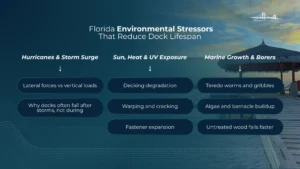
Florida Environmental Stressors That Reduce Dock Lifespan.
Ever heard that Mother Nature is a capricious thing? Well, for docks, she can be kinda brutal.
Even the best-designed dock with top-notch materials will face Florida’s natural challenges.
Hurricanes and Storm Surge
Our weather can become pretty violent sometimes; it’s part of the reality we all live in.
And with climate change becoming part of our routine, storm surge and hurricane-force winds are only more of a threat.
The most sturdy docks can take a beating. Often, the damage isn’t obvious immediately; pilings loosen, fasteners fail, and boards warp. That’s why docks usually show problems after storms, not during.
Sun, Heat, and UV Exposure
Florida sun isn’t messing around. Over time, it dries out decking, fades surfaces, and weakens boards. Heat makes fasteners expand and contract, slowly loosening connections. A dock may look fine from the shore, but the sun is quietly chipping away at its lifespan.
Marine Growth and Borers
Beneath the waterline, tiny critters are at work, teredo worms, gribbles, algae, and barnacles. Untreated wood doesn’t stand a chance for long, while treated or protected materials hold up much better.
Even if the top looks perfect, damage often starts below the surface.
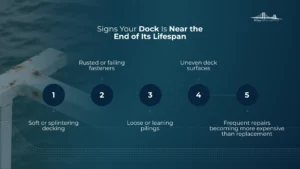
Signs Your Dock Is Near the End of Its Lifespan
Docks don’t collapse overnight.
Actually, they’re pretty great at hiding their weakest points.
From the shore, everything can look solid.
Straight lines. Clean boards. Nothing dramatic. But in Florida, deterioration usually starts quietly, below the waterline, inside fastener connections, deep in the pilings.
And by the time the damage becomes obvious, it’s often been developing for years.
So what should you be paying attention to?
Soft or Splintering Decking
If boards feel spongy or overly flexible under your feet, that’s not just aging; that’s structural fatigue.
Splintering, cracking, or soft spots usually mean moisture has worked its way inside. In Florida’s humidity, that process doesn’t take long.
Rusted or Failing Fasteners
Those bolts and brackets might seem small, but they’re doing serious work.
If you see rust streaks, corrosion, or hardware pulling loose, that’s a warning sign. In saltwater environments, especially, fastener failure can happen faster than most homeowners expect.
And when connections weaken, the structure follows.
Loose or Leaning Pilings
A dock should feel stable. Solid. Predictable.
If you notice shifting, leaning pilings, or movement when you walk across it, something underneath has changed. Soil conditions, storm stress, or years of wave action may be catching up.
Pilings are your foundation. When they move, everything else is on borrowed time.
Uneven Deck Surfaces
High spots. Dips. Boards that don’t sit quite right anymore.
Uneven surfaces usually point to framing issues or settling below the surface. It may seem minor now, but small misalignments often signal deeper structural stress.
Repairs Are Becoming Routine
Replacing a board here and there? Normal.
But if you’re tightening bolts every season, swapping hardware constantly, or fixing the same issues repeatedly, you’re likely managing symptoms, not solving the problem.
At some point, repairs stop extending lifespan and start delaying the inevitable.
How to Extend the Lifespan of a Dock in Florida
Smarter Design Choices
If you’re already repairing or partially rebuilding, that’s your opportunity to improve, not just replace.
Instead of swapping materials like-for-like, consider upgrades that add years:
- Upgrade to marine-grade framing or aluminum where possible.
- Use stainless steel hardware instead of galvanized.
- Reinforce high-stress zones (boat lifts, corners, heavy-traffic areas)
- Improve connection points and bracing.
Small structural improvements can now dramatically extend your dock’s lifespan in Florida.
Preventative Maintenance
This is where most docks lose years.
A simple routine can make a major difference:
- Schedule an annual inspection (especially after hurricane season)
- Replace corroded fasteners before they fail.
- Clean algae, barnacles, and marine buildup regularly.
- Check for early signs of movement or soft decking.
Planning for Future Conditions
The dock you build today should still make sense 10–20 years from now.
Think ahead:
- Account for gradual sea level changes.
- Plan for larger boats or heavier lifts.
- Ensure upgrades meet current Florida building codes.
- Design with storm resilience in mind.
Building only for today can shorten your dock’s usable life tomorrow.
FAQs About Dock Lifespan in Florida
Does saltwater reduce dock lifespan?
Yes, often dramatically. Saltwater accelerates corrosion, fastener failure, and marine growth. Docks in intracoastal, bay, or oceanfront locations typically experience more wear than docks on freshwater lakes.
What dock material lasts the longest in Florida?
Marine-grade aluminum framing and concrete pilings generally offer the longest lifespan in Florida’s coastal conditions. Composite decking also performs well against UV exposure, but the substructure ultimately determines how long the dock will last.
How often should a dock be inspected in Florida?
At least once per year, and always after major storms. Regular inspections help identify hidden issues, such as corroded fasteners, loose pilings, or early structural movement, before they become major repairs.
Is it better to repair or replace an old dock?
It depends on the extent of the damage. If structural components like pilings and framing are still sound, repairs may extend the dock’s life. But if repairs are becoming frequent and costly, replacement is often the safer long-term investment.
Can hurricanes shorten a dock’s lifespan even if it looks fine?
Absolutely. Storm surge and lateral forces can weaken connections and pilings without obvious surface damage. That’s why post-storm inspections are critical in Florida.