
It starts as a simple idea.
You picture a nice, functional walkway stretching out over the water; it’s just a small place, nothing out of the ordinary.
Then the quotes start coming in… and suddenly you are confused.
Someone suggests costs of $20k, and another mentions numbers over $80k,
The reason?
Design
The way your dock is designed, its shape, elevation, pilings, flow, and features, influences a good share of the final price. In places like Florida, design can be the difference between a dock that lasts decades and one that gets destroyed by the first bad storm.
This article will explain why design matters so much, and help you to plan a dock that fits your lifestyle and your budget, all while keeping things safe.
Why Design Matters?
When you think about design, you usually think of aesthetics, add-ons that aren’t really necessary.
Except when it comes to docks
The structure, the stability, the comfort, the longevity, the vibe, all of it starts with design choices.
Good design prevents:
- Unnecessary pilings
- Wrong elevations
- Wasted square footage
- Conflict with environmental rules
- Expensive engineering fixes
- Recurring maintenance issues
- Storm damage you could have avoided
Poor design might seem like a cheaper alternative, but only before you have to deal with the consequences.
How Good Design Saves You Money

Now, of course, material prices are part of the story, but it wouldn’t be accurate to say that they are the sole factor; the design choices you make are what are going to determine how much you spend and how much money you save.
Fewer pilings
Pilings are one of the costliest parts of a dock.
If the design uses the right geometry, you reduce the number needed without sacrificing strength. That immediately lowers the budget.
No wasted square footage
You don’t pay for useless corners, oversized platforms, or walkways that don’t fit your waterfront. Every board has a purpose.
No constant repairs
A dock that’s too low will suffer constant wave damage. Too high and it becomes impractical. Florida’s tides + weather require surgical precision.
Better compliance
Permitting in Florida can feel like a labyrinth at some points
A design that understands local, State, and Federal environmental regulations gets approved faster, costing you less in time and revisions.
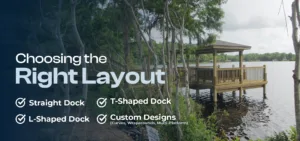
Choosing the Right Layout
Because, yes…
Colors and decorations are pretty, but first you need to focus on the layout. This is what determines your structural cost.
Let’s walk through the most common shapes and how they influence your budget.
Straight Dock
Are you looking for something super functional?
This is the one you need
A straight dock is probably the most budget-friendly shape. A single walkway that leads straight out. Perfect if:
- Your waterfront is narrow
- You don’t need large platforms
- Your boat sits elsewhere
If your budget is limited and you want a solution that works, a straight dock could be something to consider.
L-Shaped Dock
Do you have a boat?
This type of dock includes a side extension at the end, perfect for tying off a boat or creating a small seating area.
Naturally, you’ll find costs increasing slightly because:
- More framing
- More decking
- Additional pilings
Still very reasonable, and incredibly functional.
T-Shaped Dock
A pretty popular option and with good reasons.
The end platform creates a spacious, multi-purpose area for fishing, cleaning gear, or just lounging.
Costs rise with the added width and materials, but this design gives you serious versatility without jumping to luxurious prices.
Custom Designs (Curves, Wraparounds, Multi-Platform)
Not to brag or anything, but this is where Fender Marine shines.
Custom layouts step away from monotonous docks and create something tailored to how you live:
- Sunset platforms- Covered and Uncovered
- Multiple slips
- Covered Boat House
- Kayak launches
- Curved walkways- Meandering through your lakefront water scaping
- Integrated seating
- Tiered levels- Roof Top Decks
These are premium designs, and they influence the budget, but they’re also the ones that transform your backyard into a waterfront experience instead of just a construction over the water.
How to Design a Dock Fitting Your Lifestyle

The great thing about docks is that they can literally fulfill any purpose you wish.
A launch pad for weekend boating? Check.
A peaceful fishing deck? Of course.
An outdoor living room, or a mix of all three? All possible.
When design starts with your lifestyle, you avoid paying for features you don’t need and missing the ones you’ll use daily.
If You’re a Boater
The dock needs to flow with your vessel, not fight it. That affects:
- Overall Layout- required water depth, water currents if any, setbacks from side yards, and maximum distance to the end of the dock from the shoreline.
- Angle of boat slip entry
- Width and length of boat slip- Design for not only the boat you will have but what boat you may have in the future or a standard size boat that is used in the area.
- Lift if any type and integration into the structure will
Designing the lift position early saves a lot of money compared to retrofitting it later.
If You Fish
You don’t need a massive dock, you need smart placement.
A T-platform, rod holders, railing, rail lighting, depth of water is important, built in seating is a nice option and can be added in the design phase cost less and work better long term.
If Leisure is the Goal
This is where fun design begins. You might want:
- Built-in furniture, including cabinets and refrigerators
- Brazilian hardwood, Pine, or composite decking
- Shade structures/covered activity decks
- Integrated lighting-dock walkway lighting, under-dock lighting, underwater lighting, ceiling lighting, and other options
- Ceiling fans
- Audiovisual systems
Entertainment docks usually trend mid-to-high budget because they create usable living space. No need to tell you, the lifestyle payoff is huge.
If You Just Love Water Views
The design becomes about sightlines. Subtle choices like railing styles, platform placement, and deck height can make your yard feel twice as open, without necessarily doubling the cost.
So yes, designing the dock around your lifestyle is seriously smart.
Structural Design

Okay, time to get into a bit of technical stuff.
The structural engineering of your dock is where design meets reality.
This is what determines how well it handles bad weather, humidity and daily use.
Dock Height
It’s common practice that Florida docks need to sit above average high tide, plus enough clearance to handle storm surge.
Getting this wrong leads to expensive repairs. Remember this structure will co-exist with mother nature and she’s always capricious.
Span Distances
Longer spans require thicker framing and more robust materials. This raises cost, but it also reduces the number of pilings. Another example of where design strategy saves money.
Piling Spacing
Wider spacing = fewer pilings (lower cost)
Closer spacing = stronger stability (higher cost)
Your design should balance safety, aesthetics, and budget.
Deck Width
A narrow walkway costs less, but…a wider one feels safer and more comfortable.
The sweet spot depends on your needs and the look you want.
These structural decisions aren’t glamorous, but they’re the reason some docks remain rock-solid for decades while others sag in half that time.
Material Design: Style and Durability
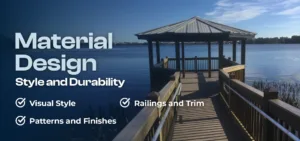
Visual Style
Your decking instantly sets the tone.
Wood feels warm and classic. Composite gives you clean lines and modern colors. PVC blends durability with a sleek finish.Design determines how those materials are cut, joined, and patterned.
Patterns and Finishes
This is where docks go from useful to plain gorgeous.
- Diagonal decking
- Picture framing
- Herringbone patterns
- Contrasting borders
Railings and Trim
Railings define the style of your dock:
- Cable rail gives a modern vibe.
- Wood rail is more old-fashioned.
- Glass rail, perfect if you are craving for the view.
- Low-profile rail, simple but good.
Trim, post caps, and lighting integration all shape the final look and the final cost.
Lighting, Shade, and Experience.
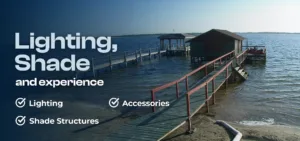
These elements are where your dock becomes usable after dark, during heat, or for gatherings.
Lighting
Who doesn’t love a dock surrounded by lights?
You can keep it simple or go all-in with:
- Under-rail LEDs
- Pathway lighting
- Underwater lights
- Integrated step lights
Lighting is one of the most budget-flexible elements; it won’t have a serious impact on the structure, but it can certainly make things more…romantic.
Shade Structures
Pergolas, tiki coverings, or full roof systems turn your dock into an outdoor room. They require design, engineering, and permitting, which influence the budget.
Accessories
Benches, kayak slips, storage, and utilities all become cheaper when included in the original design.
So What Does a Dock Really Cost in Florida?
The real answer is kind of simple:Your design choices determine your budget.
A straight, functional dock is your most affordable choice.A mid-range custom layout with a lift and seating platform raises your investment.A premium dock with custom curves, lighting, shade, and lifestyle features becomes a full outdoor living space, and the centerpiece of your waterfront.
None of these is better or worse.
They’re simply different expressions of how you want to use your water.
Fender Marine Construction specializes in custom docks, piers, boathouses, seawalls, and other waterfront structures, designed for how you want to live by the water.
We’ll talk through your site, your lifestyle, and your dreams, then we’ll show you design options that match your vision and your budget.