
Most people start their boat lift journey the same way: scrolling through options, comparing prices, and asking:
Which lift is the best?
It feels logical.
But here’s something to remember: choosing the right boat lift has very little to do with the equipment itself. It starts long before that, with design.
Every waterfront is different. Water depth changes. Shorelines behave their own way. Docks weren’t all built with the same loads in mind. When those realities aren’t considered upfront, even the best boatlifts end up giving you a headache.
Get the design right, and the equipment naturally falls into place. Get it wrong, and no amount of upgrades will fully fix it.
The good news?
This article will help you to understand why design should always come first, and how it makes choosing the right boat lift a whole lot easier.
Why Boat Lift Design Comes Before Equipment
Boat Lift Equipment Follows the Design
It’s easy to think of a boat lift as something you choose first and adapt later. In reality, the equipment is simply the outcome of the design, not the starting point.
Water depth, dock structure, shoreline conditions, and how the boat will be used all shape the design.
Once those elements are understood, the right equipment naturally follows. When they’re ignored, even high-quality equipment ends up working harder than it should.
Poor Design Leads to Problems
When design is rushed or overlooked, the issues tend to surface quickly. Lifts struggle to perform smoothly, require frequent adjustments, and experience faster wear and tear. Maintenance costs rise, and the overall lifespan of the lift shortens.
In most cases, the equipment you choose isn’t the problem; the problem is that it’s being forced into conditions it was never designed to handle.
Good Design Improves Safety and Costs
A well-designed boat lift operates as planned 24/7.
It supports the boat where it should, handles changing water conditions, and reduces stress on both the lift and the dock.
For you, this means higher levels of safety, better protection for your boat, and fewer long-term expenses.
When the design is done right from the start, you spend less time fixing problems and more time enjoying the water.
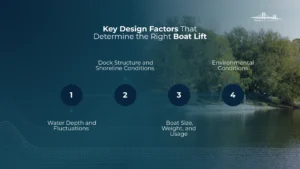
Key Design Factors That Determine the Right Boat Lift
Before you ever get to equipment, you need to understand the conditions your boat lift will live in every single day.
What are your main expectations?
Will you be using it regularly or just occasionally?
The more precise you are regarding the reasons you need a boat lift, the better the outcome will be.
Water Depth and Water Level Changes
Designing around ideal conditions is a common mistake.
When water drops lower than expected, lifts can lose clearance, strain motors, or stop functioning altogether. Inaccurate guesses often lead to costly retrofits that could have been avoided with proper planning.
- Are your water levels stable, or do they change with tides or seasons?
- How much swing do you see during storms or heavy rain?
- What happens during extreme low-water conditions, not average ones?
Dock Structure and Shoreline Conditions
Think your dock has nothing to do with how well a boat lift fares?
Think again
If the dock wasn’t designed with lift loads in mind, the stress shows up over time.
Movement, uneven lifting, and long-term structural wear are usually signs that the dock and lift weren’t designed together.
Some things you need to consider include:
- Is your dock fixed or floating, and how does it respond to water movement?
- Are you dealing with a seawall, pilings, or a natural shoreline?
- Where is the load being transferred when the boat is fully lifted?
Boat Size, Weight, and How You Actually Use It
This is where on paper and real life might have some issues.
A lift designed for light, occasional use won’t hold up the same way under frequent launches. Even when the capacity rating looks right, usage patterns can change how the lift performs and how long it lasts.
Environmental Conditions Around Your Dock
Your lift is constantly exposed to forces you don’t always notice.
It could be:
- Wind exposure or wave action.
- Saltwater vs freswater.
- Debris, marine growth, or sediment buildup.
These conditions influence everything from material choice to long-term maintenance.
When they’re overlooked, corrosion, binding, and premature wear become yet another problem to deal with.
Common Boat Lift Design Mistakes to Avoid
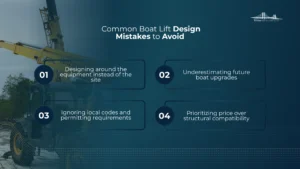
Designing Around the Equipment Instead of the Site
This is the most common mistake, and it usually starts with good intentions.
You find a lift you like, or one that fits the budget, and then try to make it work at your dock. The problem is, your site doesn’t change just because the equipment looks good on paper.
If the lift is chosen first, the design gets forced to adapt. That’s when you see awkward installations, uneven lifting, and equipment that feels like it’s always compensating for something.
The site should dictate the design, and the design should dictate the equipment, never the other way around.
Underestimating Future Boat Upgrades
Most people design for the boat they have today, not the one they’ll own in a few years.
And again, it makes almost sense…until you think about it.
Depending on your life circumstances, you might upgrade to a heavier model, add more gear, or switch boat types altogether.
You need to have that on mind, otherwise you’re left with limited options, or worse, starting over.
Designing with a little headroom upfront is far more cost-effective than replacing a lift because it barely meets today’s needs.
Ignoring Local Codes and Permitting Requirements
Permitting isn’t the exciting part of a boat lift project, but ignoring it can create serious headaches.
Local codes often dictate allowable loads, setback requirements, environmental protections, and installation methods. When these rules aren’t considered during the design phase, projects get delayed, redesigned, or flagged after installation.
Price Over Structural Compatibility
It’s tempting to focus on the upfront price, especially when different options look similar at a glance.
But a lift that isn’t structurally compatible with your dock, shoreline, or water conditions will cost more over time. Increased maintenance, repairs, and early replacement quickly erase any initial savings.
The goal isn’t to find the cheapest lift.
It’s to find the one that fits your site correctly and holds up long-term.
How Custom Boat Lift Design Solves These Challenges
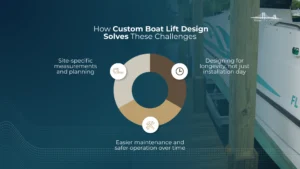
Designing for the Site First
Custom boat lift design flips the process the right way around. Instead of forcing equipment to fit your dock, the design starts with your site and works outward.
That means taking into account things like:
- Actual water depth and seasonal changes.
- Dock structure and load paths.
- Shoreline conditions and exposure.
When the site leads the design, the equipment becomes a natural fit, not a compromise.
Designing for Current and Future Boats
A smart design doesn’t just account for what you’re lifting now. It builds in flexibility for the future.
That could mean:
- Allowing for additional weight and accessories.
- Planning for a different boat type down the line.
- Avoiding capacity limits that leave no room to grow.
Permits and Code Requirements
Custom design goes beyond just performance, focusing on the legal aspect from day one.
When codes and permitting requirements are considered during the design phase:
- Installations move faster.
- Redesigns are avoided.
- Surprises during inspections are minimized.
Structural Compatibility That Reduces Long-Term Costs
A custom-designed boat lift works with your dock and environment naturally.
By matching the design to structural realities:
- Loads are properly distributed.
- Stress on the dock and lift is reduced.
- Maintenance becomes less frequent and more predictable.
That’s how you get longer service life, fewer repairs, and better protection for both your boat and your dock.
Boat Lift Design Types
Once the main site conditions are understood, the type of boat lift usually becomes clearer. Different options exist because waterfronts behave differently, not because one approach is better across the board.
What works well in one location can struggle in another.
Vertical Boat Lift
When you choose a vertical lift, the boat is raised straight up and out of the water.
This option works best where water depth is consistently adequate, and the dock or supporting structure can handle vertical loads.
One of the strongest points here is clearance. Lifting the boat completely out of the water offers excellent protection, but only when depth and structure have been properly accounted for. If water levels drop more than expected or the dock wasn’t designed for that kind of load, performance issues tend to show up quickly.
Cantilever Boat Lift
Cantilever lifts rely on a pivoting motion rather than straight vertical travel, which makes them a common solution in areas with limited water depth.
When you go this route, balance becomes critical. Weight distribution, alignment, and dock strength all play a role in how smoothly the lift operates. Done right, it’s a simple and effective option.
Floating Boat Lift
With floating lifts, the boat rises and falls with the water level. This makes them especially useful in locations with tidal movement or significant seasonal changes.
Go for this if you prioritize adaptability.
Because the lift moves with the water, depth is less of a constant concern. That said, anchoring and exposure matter more here. Without proper planning, movement, wear, and long-term stability can become issues.
Piling-Mounted Boat Lift
Piling-mounted lifts are supported by pilings driven into the seabed and are often paired with fixed docks or seawalls.
Stability here matters as it handles heavier loads and wave action well, but it requires careful planning around load transfer and local permitting. If integrated properly, it offers long-term strength and reliability.
Final Thoughts
Water depth, dock structure, shoreline conditions, and how you actually use your boat all shape what will work, and what won’t. When those factors lead the process, the equipment becomes a natural fit instead of a compromise.
A design-first approach saves you from constant adjustments, unnecessary maintenance, and premature replacements.
More importantly, it protects your boat, your dock, and your investment over the long term.
If there’s one takeaway, it’s this: the best boat lift decisions don’t start with equipment. They start with design.
Frequently Asked Questions About Boat Lift Design
Should I choose a boat lift before evaluating my site?
No. Your site conditions should always come first. Water depth, dock type, and environmental factors determine what lift options will actually perform well long-term.
What happens if my water levels change seasonally?
Seasonal changes can affect clearance, performance, and safety. Designing for the lowest and highest water levels helps avoid future modifications or operational issues.
Can I design a lift for a future boat upgrade?
Yes, and you should. Planning for additional weight or a different boat type upfront is usually far more cost-effective than replacing a lift later.
Do local codes really affect boat lift design?
Absolutely. Local regulations can influence allowable loads, installation methods, and placement. Ignoring them can lead to delays, redesigns, or compliance issues after installation.
Is a more expensive boat lift always better?
Not necessarily. The right lift is the one that matches your site conditions and usage. A lower-priced option that fits properly will outperform a more expensive one that doesn’t.